Federated Learning Over Blockchain for Collaborative AI Training
DOI:
https://doi.org/10.63345/sjaibt.v2.i2.303Keywords:
Federated Learning, Blockchain, Collaborative AI, Smart Contracts, Privacy-Preserving Machine Learning, Decentralized AI, Data IntegrityAbstract
Federated Learning (FL) has emerged as a decentralized machine learning paradigm that enables multiple participants to collaboratively train models without directly sharing their sensitive local data. This paradigm addresses privacy concerns while allowing scalable model development across distributed data silos. However, traditional FL architectures still suffer from critical limitations: trust issues among participants, susceptibility to single-point failures, and vulnerabilities in maintaining data and model update integrity. Blockchain, with its immutable ledger, decentralized consensus, and incentive mechanisms, offers a promising infrastructure to overcome these challenges.
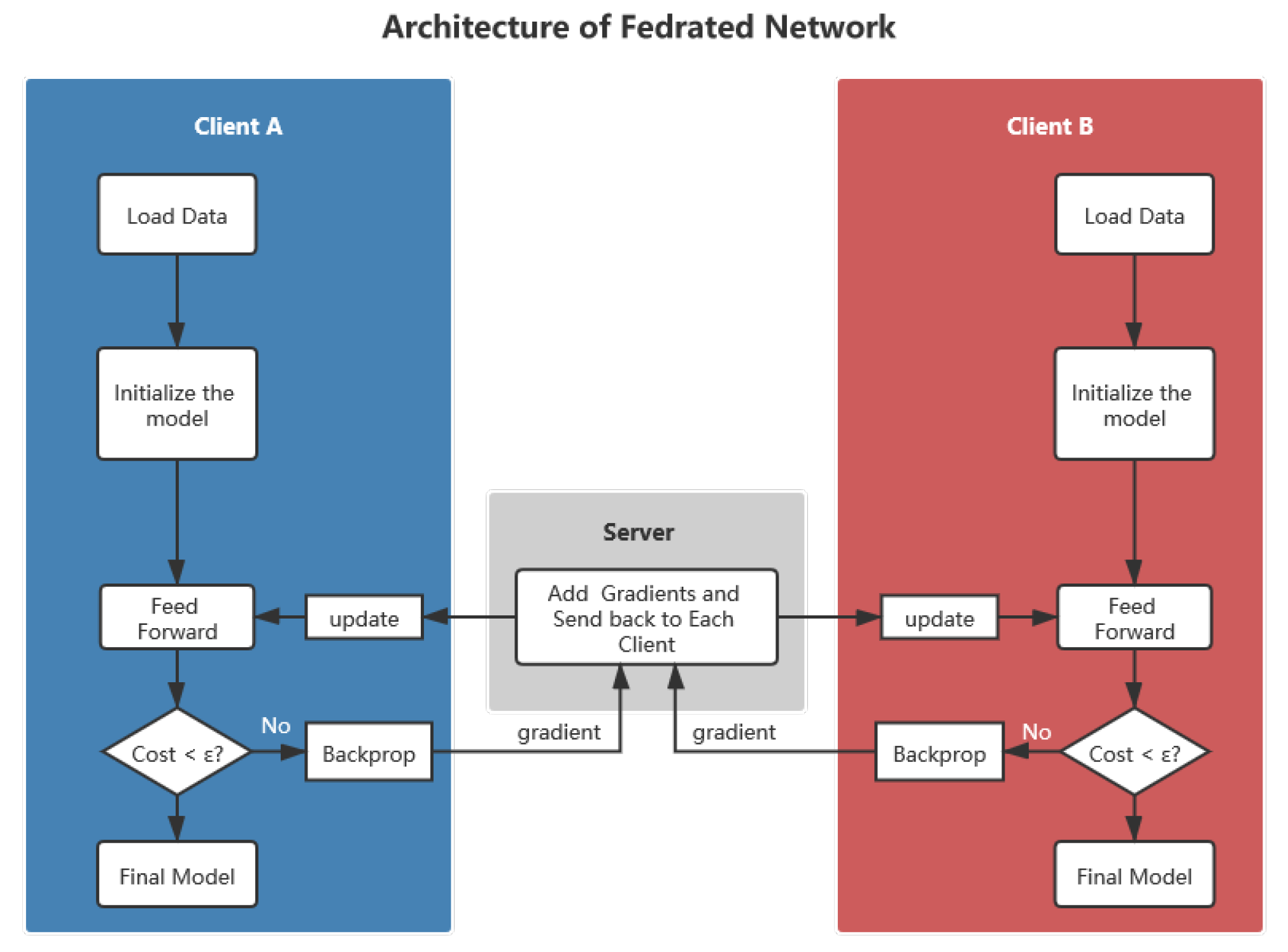
This manuscript explores the integration of blockchain into federated learning frameworks to establish a trustworthy, transparent, and collaborative ecosystem for Artificial Intelligence (AI) training. The study begins with an extensive literature review on FL architectures, blockchain frameworks, and their synergies. It then proposes a blockchain-enhanced federated learning methodology that employs smart contracts for model aggregation, token-based incentives for honest participation, and decentralized consensus to ensure tamper-proof recording of model updates. A detailed methodology is presented, emphasizing architecture, communication protocols, cryptographic primitives, and consensus mechanisms.
Experimental simulations and comparative evaluations demonstrate that blockchain-enabled FL improves robustness, transparency, and fairness, while maintaining privacy guarantees. Results highlight improvements in trustworthiness of updates, reduced vulnerability to poisoning attacks, and enhanced auditability across participating nodes. However, challenges remain, particularly in terms of scalability, latency, and energy efficiency.
The manuscript concludes that blockchain-integrated FL represents a transformative step toward secure collaborative AI training, particularly relevant in healthcare, finance, and smart cities. Future research must focus on lightweight blockchain protocols, energy-efficient consensus, and adaptive incentive mechanisms to enable large-scale adoption.
Downloads
References
• https://kms-technology.com/wp-content/uploads/2023/05/unnamed-1.png
• Bonawitz, K., Eichner, H., Grieskamp, W., Huba, D., Ingerman, A., Ivanov, V., … & Van Overveldt, T. (2019). Towards federated learning at scale: System design. Proceedings of Machine Learning and Systems (MLSys), 1, 374–388.
• Kairouz, P., McMahan, H. B., Avent, B., Bellet, A., Bennis, M., Bhagoji, A. N., … & Zhao, S. (2021). Advances and open problems in federated learning. Foundations and Trends in Machine Learning, 14(1–2), 1–210. https://doi.org/10.1561/2200000083
• Li, T., Sahu, A. K., Talwalkar, A., & Smith, V. (2020). Federated learning: Challenges, methods, and future directions. IEEE Signal Processing Magazine, 37(3), 50–60. https://doi.org/10.1109/MSP.2020.2975749
• Nakamoto, S. (2008). Bitcoin: A peer-to-peer electronic cash system. Retrieved from https://bitcoin.org/bitcoin.pdf
• Xu, R., Li, J., Wang, F., & Liu, Y. (2021). A blockchain-based federated learning framework for privacy-preserving AI. IEEE Internet of Things Journal, 8(4), 3450–3460. https://doi.org/10.1109/JIOT.2020.3027713
• Kim, H., Park, J., Bennis, M., & Kim, S. L. (2020). Blockchained on-device federated learning. IEEE Communications Letters, 24(6), 1279–1283. https://doi.org/10.1109/LCOMM.2020.2970744
• Ramanan, P., & Nakayama, K. (2020). BAFFLE: Blockchain-based aggregation for federated learning. IEEE Access, 8, 428–436. https://doi.org/10.1109/ACCESS.2020.2965367
• Zhang, C., Xie, Y., Bai, H., Yu, B., Li, W., & Gao, Y. (2021). A survey on federated learning. Knowledge-Based Systems, 216, 106775. https://doi.org/10.1016/j.knosys.2021.106775
• Zyskind, G., Nathan, O., & Pentland, A. (2015). Decentralizing privacy: Using blockchain to protect personal data. 2015 IEEE Security and Privacy Workshops, 180–184. https://doi.org/10.1109/SPW.2015.27
• Liu, Y., Kang, J., Niyato, D., Wang, P., & Zhang, S. (2020). A secure federated learning framework for 5G networks. IEEE Network, 34(4), 24–31. https://doi.org/10.1109/MNET.001.1900591
• Yang, Q., Liu, Y., Chen, T., & Tong, Y. (2019). Federated machine learning: Concept and applications. ACM Transactions on Intelligent Systems and Technology (TIST), 10(2), 1–19. https://doi.org/10.1145/3298981
• Shokri, R., & Shmatikov, V. (2015). Privacy-preserving deep learning. Proceedings of the 22nd ACM SIGSAC Conference on Computer and Communications Security, 1310–1321. https://doi.org/10.1145/2810103.2813687
• Lu, Y., Huang, X., Zhang, K., Maharjan, S., & Zhang, Y. (2020). Blockchain and federated learning for privacy-preserved data sharing in industrial IoT. IEEE Transactions on Industrial Informatics, 16(6), 4177–4186. https://doi.org/10.1109/TII.2019.2942190
• Hard, A., Rao, K., Mathews, R., Ramaswamy, S., Beaufays, F., Augenstein, S., … & Eichner, H. (2018). Federated learning for mobile keyboard prediction. arXiv preprint arXiv:1811.03604.
• Sharma, V., You, I., Kul, G., & Choudhary, G. (2021). Secure and sustainable federated learning with blockchain: A systematic survey. Sustainable Computing: Informatics and Systems, 30, 100512. https://doi.org/10.1016/j.suscom.2021.100512
• Pokhrel, S. R., & Choi, J. (2020). Federated learning with blockchain for autonomous vehicles: Analysis and design challenges. IEEE Transactions on Communications, 68(8), 4734–4746. https://doi.org/10.1109/TCOMM.2020.2993140
• Majeed, A., & Hong, C. S. (2020). FLchain: A blockchain-enabled federated learning framework. Electronics, 9(3), 487. https://doi.org/10.3390/electronics9030487
• Wu, Y., He, Q., Chen, X., & Chen, F. (2020). FedBC: Blockchain-based federated learning with privacy preservation. IEEE International Conference on Communications Workshops (ICC Workshops), 1–6. https://doi.org/10.1109/ICCWorkshops49005.2020.9145161
• Chen, M., Challita, U., Saad, W., Yin, C., & Debbah, M. (2019). Artificial neural networks-based machine learning for wireless networks: A tutorial. IEEE Communications Surveys & Tutorials, 21(4), 3039–3071. https://doi.org/10.1109/COMST.2019.2926625
• Ng, D. W. K., Shikh-Bahaei, M., & Poor, H. V. (2021). Future of federated learning: Privacy, security, and efficiency. IEEE Journal on Selected Areas in Communications, 39(12), 3659–3679. https://doi.org/10.1109/JSAC.2021.3118387
Downloads
Published
Issue
Section
License
Copyright (c) 2025 Scientific Journal of Artificial Intelligence and Blockchain Technologies

This work is licensed under a Creative Commons Attribution-NonCommercial 4.0 International License.
The license allows re-users to share and adapt the work, as long as credit is given to the author and don't use it for commercial purposes.